


1
/
of
4
IL BIACCO
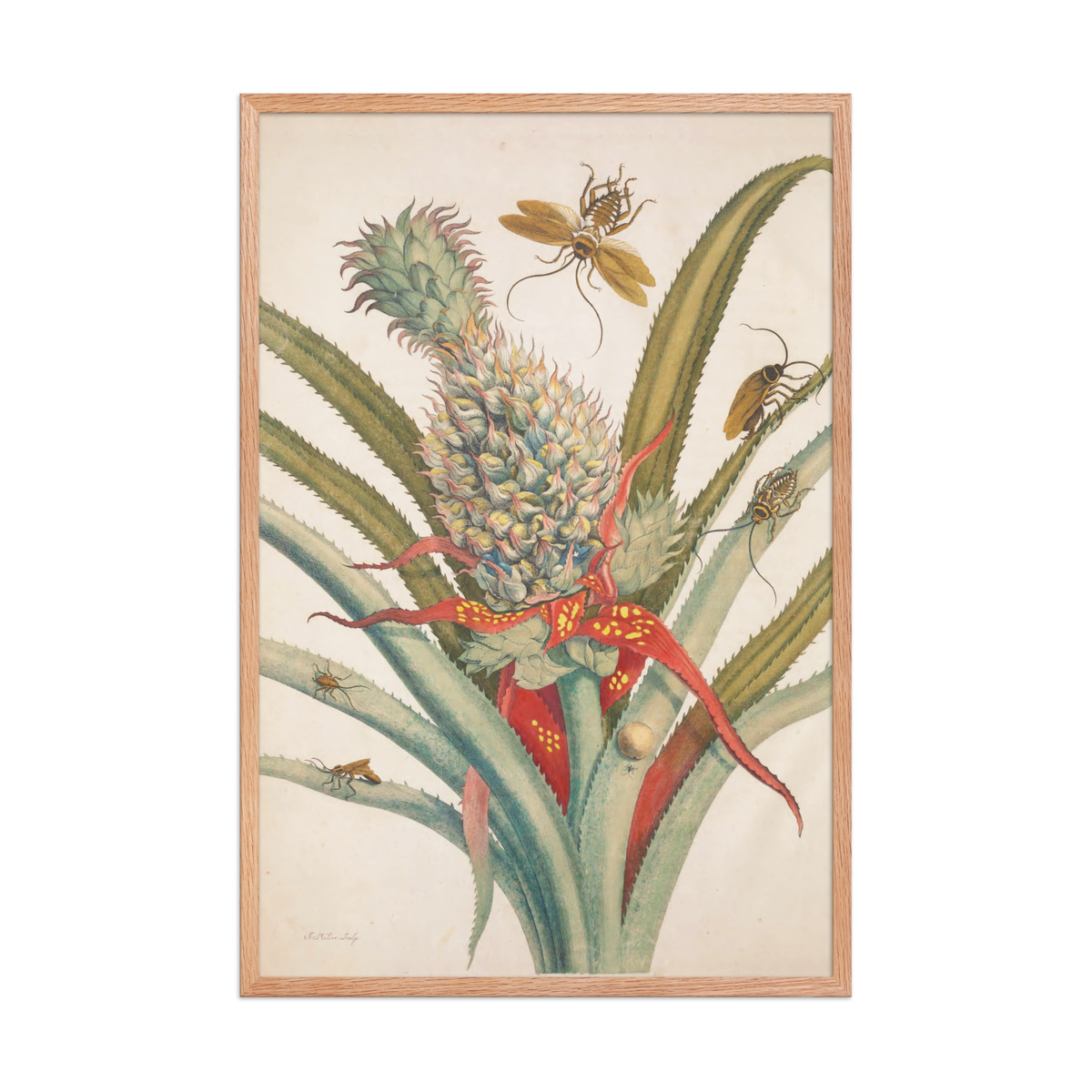
Pineapple with Australian and German Cockroaches ca. - 1705
Pineapple with Australian and German Cockroaches ca. - 1705
Regular price
€59,00 EUR
Regular price
Sale price
€59,00 EUR
Shipping calculated at checkout.
Quantity
Couldn't load pickup availability


Collapsible content
The story behind
When Maria Sibylla Merian first set foot in Suriname, her senses were overcome with surprising tastes, sights, and smells. A dissected soursop and a hovering Owlet Moth; shining pepper plants and pineapple fibers which stung her German-born tongue. In her two years of exploration before contracting a malaria-like illness, Merian expounded upon the sweetness of watermelon, just as she dutifully detailed the long-misunderstood process of butterfly metamorphosis.
The result was a compilation of sixty elaborate engravings, Metamorphosis Insectorum Surinamensium (1705) — a fascinating catalog of New World plants, animals, and insects. Nestled within these pages, we find a fragmentary understanding of indigenous knowledge, the morsels of information which were shared with Merian by members of the enslaved population.
As a young girl growing up in Frankfurt, Merian would often travel to the countryside to search for caterpillar larvae. She raised silkworms at thirteen years old, and gave thorough attention to every subtle shift in the physiology of her specimens. When she moved to Nuremberg with her husband in 1670, she was hired to teach illustration to wealthy, unmarried women, thereby securing herself access to some of the finest gardens in Germany, elaborate oases for the insects she studied.
In 1690, now the mother of two young daughters, Merian divorced. And by 1699, after a decade of supporting herself through art, she was given permission from the city of Amsterdam to undertake research in Suriname with her youngest daughter, Dorothea. Lacking the financial backing from commercial enterprise that was typical for other Dutch naturalists, the pair stayed fiscally afloat through the sale of roughly 255 of their own paintings.
Merian’s work would not have been possible without the knowledge of enslaved peoples, both of African and Amerindian descent. Through her interactions, Merian documented indigenous plant names, as well as their traditional medicinal uses.
Returned to Amsterdam in 1701, opening a shop to sell her specimens and engravings. In 1705, Metamorphosis was published. Her engravings served as one of the first natural histories of Suriname, while her depictions of butterflies helped dispel the myth that insects were spontaneously generated out of mud and standing water. As Metamorphosis was shepherded through several editions and translations following Merian’s death in 1717, her work gained a larger audience. In spite of this, the medicinal use of the peacock flower was seemingly ignored. Instead, the plant became increasingly popular as an eye-catching, uncomplicated, ornamental shrub. First exported to Europe in the late seventeenth century, Caesalpinia pulcherrima took up residence in leading botanical gardens such as the Jardin du Roi in Paris and the Chelsea Physic Garden in London, yet was excluded entirely from the official pharmacopeias of London, Paris, and Amsterdam.
Product features
- Choice of Natural or black pinewood frames
- Printed on 250 g/m² photo paper with Matte finish
- Protective acrylic glass and ready-to-hang hardware included
- Vibrant, high-resolution prints using modern printing techniques
Shipping
Custom made product (1-2 days time production)
Europe: Shipping: 3-6 business days after production
United States: Shipping: 2-4 business days after production